blog:
A proactive approach to pharma brand positioning in uncertain political environments

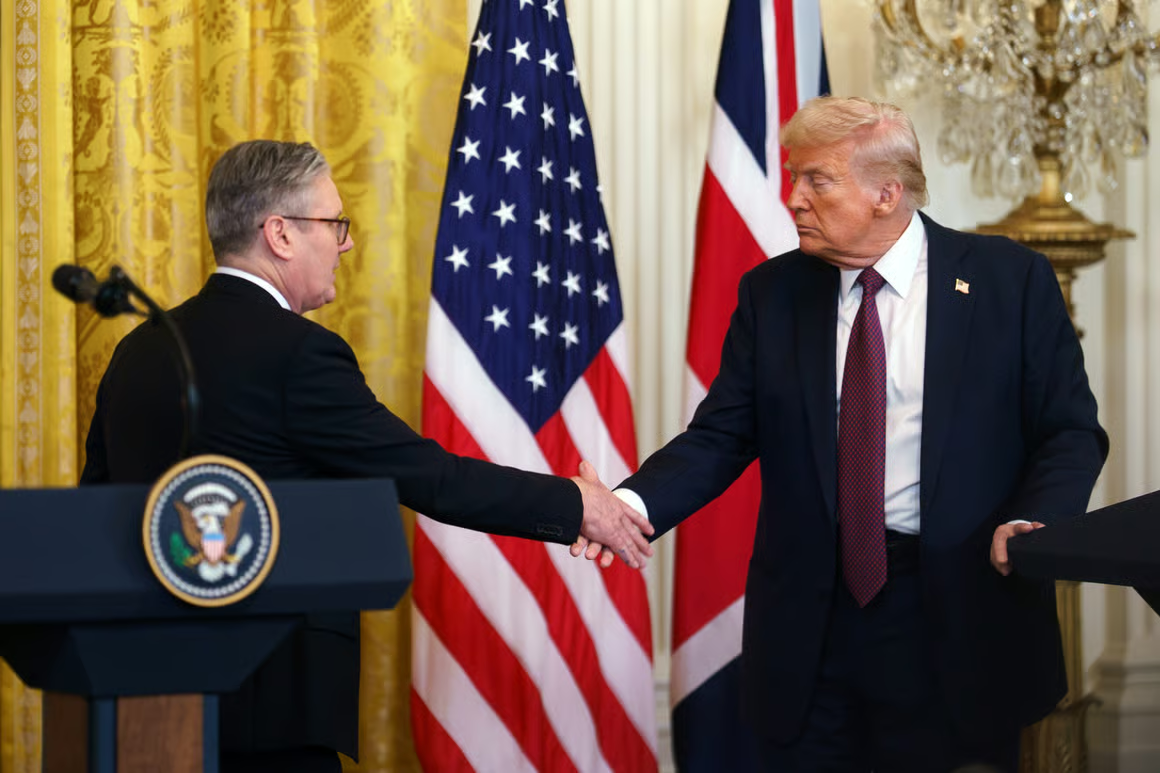
Political instability does not stay in the headlines. It moves into boardrooms, reshapes investment decisions, and eventually lands on the desks of the businesses trying to answer one question: how do we get ahead of this, rather than just respond to it?
In June 2026, Keir Starmer became the sixth British Prime Minister to resign in under a decade. With Andy Burnham expected to take office before Parliament returns in September, the UK is on course for its seventh leader in ten years. Meanwhile in Washington, the Trump administration continues to reshape the global pharmaceutical trade environment through tariff policy, pricing mandates and sweeping regulatory reform.
These are not just political events. They are commercial and strategic conditions – ones that change what your customers need to believe about you, what your competitors are saying, and whether your current positioning still earns the trust it was built to earn.
For life sciences businesses operating across both markets (or deciding whether to) the question is no longer simply what has changed. It is what remains stable enough to build on, and whether your brand is doing the work of answering that question for your customers before someone else does.
Two kinds of instability
It is tempting to view the UK and US situations as variations of the same problem. However, this would oversimplify an increasingly complex problem facing the industry. Understanding the difference matters for how pharma businesses respond strategically.
In the US, instability is largely driven by action. The Trump administration has made high-velocity interventions: threatening Section 232 tariffs of up to 100% on branded pharmaceutical imports, reshaping drug pricing policy through the Most Favoured Nation executive order, and, through the influence of Health and Human Services Secretary RFK Jr, creating genuine uncertainty for vaccine manufacturers about the regulatory and cultural environment they are operating within. Companies often need to react quickly, making proactive planning a real challenge.
In the UK, the more persistent challenge has been instability by absence. Seven Prime Ministers in ten years have not produced seven distinct policy regimes, but rather have prevented any single coherent one from taking hold. Long-term industrial strategy stalls. Government counterparties in pricing negotiations change. Commitments made under one cabinet carry uncertain weight under the next. For a sector that requires decade-long investment horizons, the absence of a stable government is its own form of structural risk.
Brexit sits across both categories. Triggered by political calculation, its consequences have been operational and structural: the UK’s exit from the EU single market created regulatory divergence between the MHRA and EMA, obliging companies to run parallel approval processes and bear duplicate compliance costs.
For CDMOs without vertically integrated supply chains, it also introduced meaningful friction in cross-border manufacturing. Active pharmaceutical ingredients and intermediates crossing multiple borders during production remain subject to a complex and inconsistent duty landscape – one that the WTO Pharmaceuticals Agreement, last updated in 2010, has never adequately resolved, and the cumulative burden of customs compliance and rules of origin requirements adds cost and friction that falls disproportionately on CDMOs and other service-dependent business models.
The investment consequence
The combined effect of political churn, the NHS pricing dispute and Brexit-related friction produced a documented decline in UK life sciences investment between 2017 and the mid-2020s.
The UK’s Voluntary Scheme for Branded Medicines Pricing, Access and Growth (VPAG) rebate, requiring pharmaceutical companies to return a percentage of branded medicine revenues to the NHS, reached 22.9% of net NHS sales for newer medicines in 2025, compared with rebate rates in the single digits elsewhere in Europe.
The investment case simply didn’t hold up for the UK against the likes of Germany, Spain or France. Several major manufacturers diverted capital accordingly, and the UK’s ranking as a destination for pharmaceutical FDI fell significantly over this period. This is the context that dominated the sector’s view of the UK. It was accurate. It is also, in part, the story of yesterday.
The reset that is now in question
In December 2025, the Starmer government reached a deal with the US that substantively changed the pharma industry on both sides of the Atlantic. Under the UK-US Economic Prosperity Deal, the UK secured zero-tariff status on pharmaceutical exports to the US – the only country to achieve this under current US trade policy, protected until January 2029.
In exchange, the UK committed to increasing NHS spending on new medicines from 0.3% to at least 0.6% of GDP by 2036, and VPAG rebates for newer medicines were capped at 15%. National Institute for Health and Care Excellence’s (NICE) cost-effectiveness thresholds were also raised, opening the door to treatments previously rejected on pricing grounds.
For the sector, this was not a minor adjustment. It was the most significant positive development in UK pharma policy in years, directly addressing the pricing structures that had driven disinvestment. Major firms including Moderna, Bristol Myers Squibb and BioNTech signaled renewed confidence in the UK as an investment destination.
Starmer’s resignation does not automatically unwind this and equally, Burnham has only just began setting out his policy platform. Markets have reacted with measured calm, reflecting continuity expectations rather than enthusiasm, and a relief that the handover appears clean rather than contested. That calm should not be mistaken for certainty.
What this means for businesses bridging both markets
For life sciences and pharma organizations with a footprint in both the UK and the US, the macro picture in mid-2026 is one of tentative uncertainty.
In the US, the environment rewards speed and adaptability. The risk of further pricing intervention and regulatory volatility under the current administration is live and ongoing. The gravitational pull toward US-based manufacturing and R&D, driven by a combination of tariff incentives and MFN pricing policy, is real. Companies are being asked, implicitly and sometimes explicitly, to make structural choices about where they build and where they invest.
In the UK, the investment environment has begun to improve, but some uncertainty remains. The NHS pricing reforms and zero-tariff US access represent a meaningful foundation. Whether that foundation holds – and what a Burnham administration chooses to build on it – is the defining question until the next general election. Businesses making long-term commitments to the UK market are effectively placing a bet on policy continuity under different cabinets.
The instability by action and instability by absence matter here because it implies different strategic responses. The US demands scenario planning, regulatory agility, and relationships that can survive political cycles. The UK demands patience, policy monitoring, and commercial structures flexible enough to adapt if the pricing environment shifts again.
Neither market is closed. Neither is straightforward. But navigating both raises a question that is easy to defer and costly to ignore.
The brand question this creates
Macro volatility does not just affect where businesses invest or how they structure their supply chains. It changes what they need to communicate, and it raises the stakes for getting that communication wrong.
When markets are unstable, the instinct is to lead with reassurance, track record and reliability. If every business in your competitive set is claiming this same thing, which many are, then differentiating should be a priority. Stability becomes the minimum required to stay in the conversation, not a reason to choose you over someone else.
In the US, customers are making decisions under pressure and on shortened timescales. The brand challenge is not to look stable but to demonstrate that you understand the specific pressures they are navigating – and that your capabilities are calibrated to those pressures. That requires positioning built on genuine strategic clarity, not reactive messaging dressed up as confidence.
In the UK, the brand challenge is different. The question buyers are quietly asking is: “Can I trust that this partner will still be the right choice in three years if the policy ground moves again?” That is a question about depth of expertise and quality of thinking, not speed of response. The businesses that will earn that trust are those that demonstrate they understand the landscape.
A proactive approach to brand positioning
This is where brand strategy and market intelligence stop being separate disciplines. The businesses that will stand out in both markets over the coming years are those that have done the work of knowing what they stand for, why it matters to the specific people they serve, and how to communicate that in a way that holds up when the landscape shifts beneath it.
That work is worth doing now, while the ground is still moving, and before the next cycle of instability makes the question more urgent.
We work with businesses navigating complex, shifting environments to build brand strategies that hold up under pressure. If the questions raised in this article are ones your business is working through, we’d welcome the conversation.
Related news, insight and opinion





Get regular updates in your inbox
Fields marked with a * are required